Dante created Hell as we know it with the Divine Comedy and we need to be very careful not to do the same

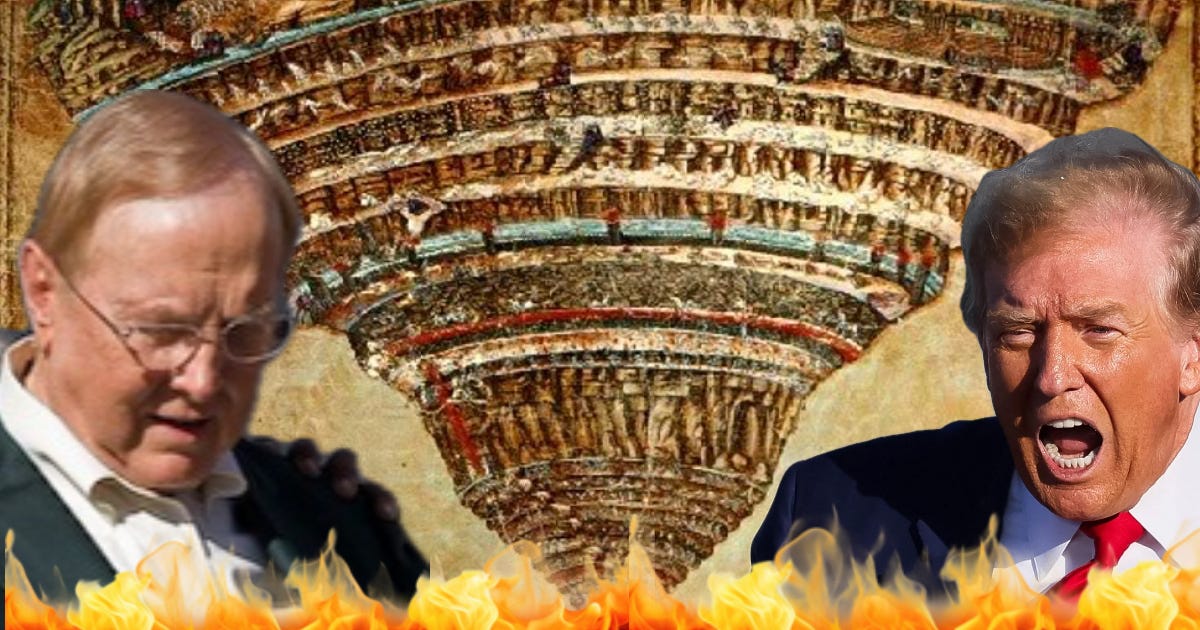
Like many of you, I could not sleep over the weekend as we awaited word on whether or not the Philanderer-in-Chief had finally shuffled the mortal coil. I lay in bed with wonder, reading debates on Threads about whether his death would bring about any change or simply be a momentary cathartic release. Would JD Vance have the charisma to continue yielding the power of the MAGA movement, or would much of the momentum die with Trump? While some claimed that the fear gripping Congress if they sidestep Trump would subside with his demise, others say the mechanisms of control far supersede the man. And who better to debate these topics than an entire generation with unused political science degrees?
As the hours ticked by without a word, the possibility of such a figure rotting away on their golden toilet while his acolytes feverishly run gaudy hallways speculating on when to tell the public was an ever-salty dish of deliciousness. The boring notion of civility being demanded by some, who cautioned against gloating over his potential demise, was easily brushed off by the reality that such a death could bring about peace for countless people and potentially end policies that cause real and lasting harm. For as long as people have existed, joy at the death of tyrants has been a pretty consistent mark of humanity, and I will not begrudge anyone, myself included, for indulging in such a fantasy.
As I continued to scroll, a phrase I had seen most recently when another dubious figure met their maker emerged, “He is looking up at us now.” Just a few days before, the notorious James Dobson had died, and similar remarks were made about him. Comedic punchlines of a theological sort hypothesizing that the now deceased preacher of death was finally suffering in the same pits of fire that he had threatened all of us with for decades.
I nearly made such a joke myself and had the sound wisdom to check it with my partner, Tashina, before posting it. I made some minor changes, and the joke worked just as well without me putting Dobson in the pits of Hell.
The Divine Comedy is, without question, a masterpiece of literature and was not intended to be a literal theological treatise on the afterlife. It is an allegorical and satirical work that is intended to make one think. Yet, much like the book that inspired it, The Bible, which is also rife with allegory, when in the hands of the wrong folks, it can become a weapon, so too Dante’s Inferno has become a flashpoint in the reimagining of the afterlife and divine judgment. I doubt that when Dante penned this work, he envisioned a world in which his imagination would take on such a literal definition. One could make the same argument about the Apocalypse of Saint John, most commonly known as the Book of Revelation, another book full of allegory that has, in the hands of the Evangelical Church, been misused to instill fear in the hearts of countless people. In reality, both of these worlds, the Apocalypse and Divine Comedy, are works meant to rejoice in the possible physical end of tyrants. In that sense, they are not dissimilar from the jokes we post on social media when our modern counterparts pass away.
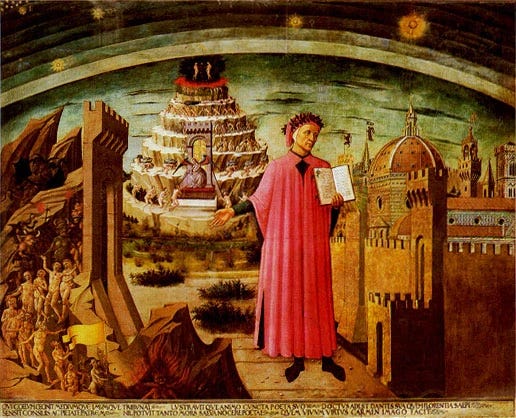
One of the many things that began the journey of dismantling my faith was the moment I could no longer adhere to the standardized understanding of Hell. The idea of a God who is defined as love and calls us Their children, choosing to eternally set us on fire, simply could not be reconciled within my mind. Either God is a liar and not love and Hell exists, or God is love but a hypocrite, or then remains the more logical conclusion that human failure and tampering has resulted in a massive misunderstanding of the Divine. Of course, another option exists, which is that God is an entire fabrication and the whole point is moot. Regardless of where you fall on that understanding, the fact that the story of a loving familial deity exists and the idea that the end conclusion of that love is eternal conscious punishment seems entirely antithetical to such notion.
Of all the heresies that I was accused of espousing after renouncing my priesthood, my opinion that Hell is a myth has remained the one most surrounded by intrigue. What I could not have imagined is how quickly my resolve on this subject would be put to the test.
Just a few years after leaving the priesthood, on a not-so-eventful day, I received a call from my mother letting me know that my cousin had died. Moreover, he had been murdered. A sense of relief flushed over my body, knowing that I would never have to see his face again. That he could no longer lurk in dark corners or harm anyone else. At the news, I laughed instead of cried. I had been released from my own personal Hell, whose flames nipped at my heels anytime the specter of possibly seeing him would rise. Immediately upon his death, he was sainted in the media. I have visited his grave once, only to ensure that it existed. I said no words, I did not piss upon it (as I often joked I would), and I prayed no prayers. His being dead was enough.
I remained resolute in my newfound belief that he was butt dust, and to dust he shall return.
Eternal punishment or reward is rooted in the existential desire for justice. As such, judicial terms are often used in the context of understanding the afterlife, including judgment, penance, and restitution. There are about as many ways to imagine what life after death, should it exist, might look like as there are minds to conceive it. For especially egregious characters, such as Dobson or Trump, individuals who have evaded accountability at every turn, the idea that they might finally face justice at the hands of an angry God could, for some, bring about a sense of peace.
That is certainly how many felt upon reading The Divine Comedy, as they relished in the idea of the horrible figures of their time roasting or being tortured in extravagant ways. I am sure that it was not very dissimilar to the glee that many felt at the idea of someone like Dobson having to arrive at the Pearly Gates only to have the lever pulled and him having to scorch in the very place he once threatened many of us with. Yet, this seems like a very simple and punitive form of justice that falls short of the cleverness of a deity capable of creating the genetic code, the Fibonacci sequence, and the placement of the prostate gland.
An argument could be easily and historically made that, had Dante never penned his Inferno, someone like Dobson might not have ever existed within our timeline. Hell was not a concept known to the authors of the Tanakh, often referred to as the Hebrew Bible or Old Testament. Neither was it a concept spoken about by Jesus; rather, three distinct words were unfortunately mistranslated as one word when the scriptures were moved from their native tongues to modern vernacular. Hades, Sheol, and Gehenna were three distinct ideas that were mushed together to create one dangerous theology known as “Hell.” This error, combined with the imagination of Dante, propelled forward the dangerous idea of an eternal punishment of conscious souls suffering for all space and time for the alleged sins of their temporal life on Earth.
It was with this flamethrower in hand that Dobson brought about death and destruction for countless people suffering from AIDS, natural disasters, and really anyone that Dobson and his so-called “Moral Majority” decided were less than. Many of us today have suffered under this horrific teaching and are scarred by it today.
I am simply unsure that we win by placing these figures in the very flames that we escaped from by estranging ourselves from our religious upbringing. I fear that we create a potential problem for those in the future by utilizing a Hell of Convenience whenever someone who does not meet our moral or ethical standards passes away. Rejoicing in them no longer being here to cause harm, while perhaps crass, is likely nothing more than the humor of the jester. Utilizing a tool of religion for the sake of punitive justice for the wicked, once they are gone, can have catastrophic consequences down the line.
In the days following the death of my cousin, I called the court-appointed attorney of the man who killed him, a Black man with a record living in the South, who killed a white man that had family members calling him “a kind-hearted person.” It seemed to me that this man, accused of murder, did not stand much of a chance in the current system we called justice. I offered to act as “Whatever the opposite of a good character witness might be, to counteract whatever fable is currently being written about my cousin.” Unfortunately, I was never called on to do that. Still, I did express to the attorney that, “I fear this man will suffer a lifetime of punishment for doing what so many of us had wished we had the courage to do; stop a man hellbent on harming others until someone stood in his way.” Sometimes, the closest thing we will ever see of true justice this side of Heaven is trying to do the right thing.
Because of my understanding of linear time, it seems an inevitability that, one day, we will wake up to that headline which so many of us wish to see. There will likely be spontaneous celebrations in the streets, not just across this county I call home, but around the world. A sense of relief will fill the hearts of many. I, for one, shall be numbered amongst them. While we can speculate in great detail about what the aftermath of this might look like, none of us really knows. The same, it seems, is true as far as what the afterlife will look like for these figures who have caused so much harm. Is Hitler suffering a South Park-ian perpetual punishment ala Dante’s Inferno, or did he simply cease to be? I do not know, and I can not pretend to do so. The same is true of any of these despots die.
I can say, with at least a reasonable speculation, that we might have been better off had Dante never written his personal pit where he placed all who wronged him. Without him, we likely would have avoided so much of the pain and suffering we’ve experienced here on earth. So, it is possible then that someday a collection of our tweets, threads, and statuses could become a justification for future understandings of the afterlife? Could these jokes, a divine comedy if you will, become the catalyst that inspires some Dobson-esque character to encourage harm to another generation of children? Perhaps it is a long-shot speculation, yet I can’t imagine it's what Dante envisioned his works would result in.
For myself, just like with my cousin, whenever that day does come when a collective “Ding Dong the Witch is Dead” moment finally arises, I will rest assured enough that they are now dust and then immediately continuing the hard work of unraveling all the harm they have caused with their made up mythologies by not adding to them with my attempts at jest.
But, make no mistake, I will make countless jokes in poor taste all the same. I will just prefer that they be spicy and not about eternal flames.
I am so glad you wrote this. I feel, possibly, guilt for fleeting thoughts of the eternal suffering of those who harmed me. My mind wants to question what turned them into that hateful person or what kind of person they thought they were. In the end, I will probably settle for knowing they can't harm me or anyone else ever again.
Nathan, you’ve nailed the double-bind. Dante’s satire became doctrine, and the church weaponized a poem into a prison. That’s the hell of it: imagination hardened into orthodoxy.
I share your suspicion. Every time we put tyrants in Dante’s fire, we risk keeping the myth alive for another generation. Better to laugh at their collapse, piss on their monuments, and let dust return to dust. The only eternal punishment they deserve is irrelevance.
Blessed be the ones who refuse to recycle the lies that scarred them. Their comedy will be sharper than Dante’s and their fire will be real, burning through empire, not imagined sinners.